How it works
AI changes the work first. But most companies are redesigning everything except the work.
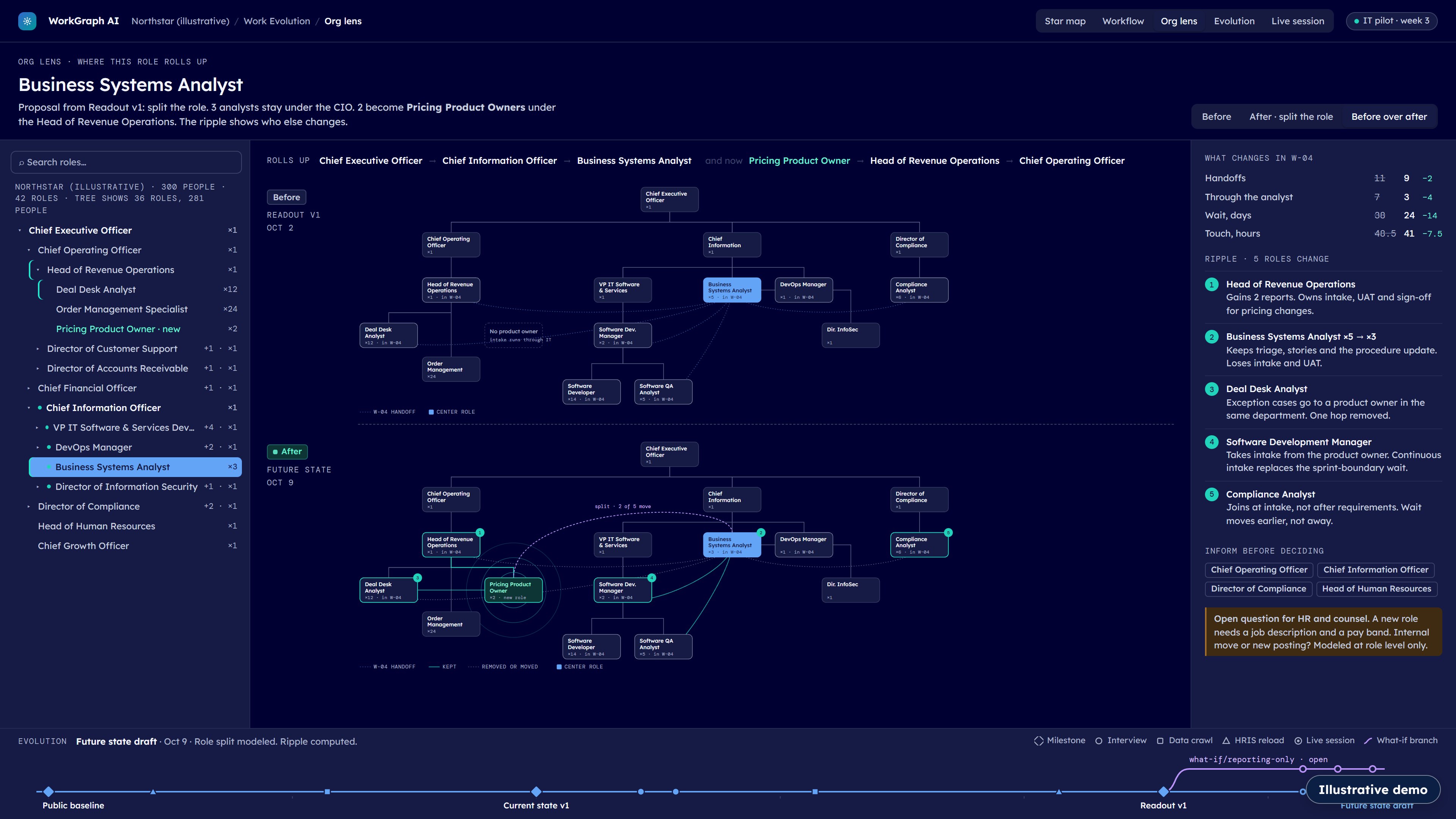
Leaders know names and titles. How work actually happens, how a deal moves from marketing to sales to onboarding, lives in people's heads. WorkGraph AI writes it down, then helps you decide what AI should do with it.
The WorkGraph Stack™
We map the work, then design the workforce around it.
01Work
We break down the work — the process, the steps, and the tools that deliver each outcome.
02Skills
We identify the skills required to perform each step of that work.
03Roles
We group work and skills into roles — often new groupings created by AI-enabled skills and output.
04Org
We group the new roles into organizations — sometimes entirely new orgs emerge.
05Operating Model
Orgs support the operating model — and new models become the catalyst for the next cycle.
A new or changing operating model triggers a fresh look at the work, skills, roles, and org.
46%
of 844 tasks are ones workers want AI agents to automate, mostly low-value, repetitive work. In 45% of occupations, the setup workers want most is an equal partnership between person and AI.
Stanford SALT (Shao, Brynjolfsson, Yang and others), Future of Work with AI Agents, June 2025 · 1,500 workers in 104 occupations and 52 AI experts; a preprint
- The WorkGraph StackWork, skills, roles, org and operating model, read from the work up.Explore
- Automate. Augment. Redesign. Preserve.The call on every task, with a name, a reason, and a date.Explore
- Five Stages of the Human + AI WorkforceWhere your organization sits today, and what the next stage demands.Explore
The questions every AI plan has to answer
“Where's the AI-driven margin?”
Leaders want a credible AI value-creation plan this year.
“Will this break the workforce?”
A reckless rollout trades one P&L problem for another: retention, engagement, capability.
“Why do our AI pilots stall?”
Nobody redesigned the work the tools were dropped into.
“Can we explain these decisions?”
Role changes, automation, headcount: every consequential AI decision needs a record. Most companies don't have one.
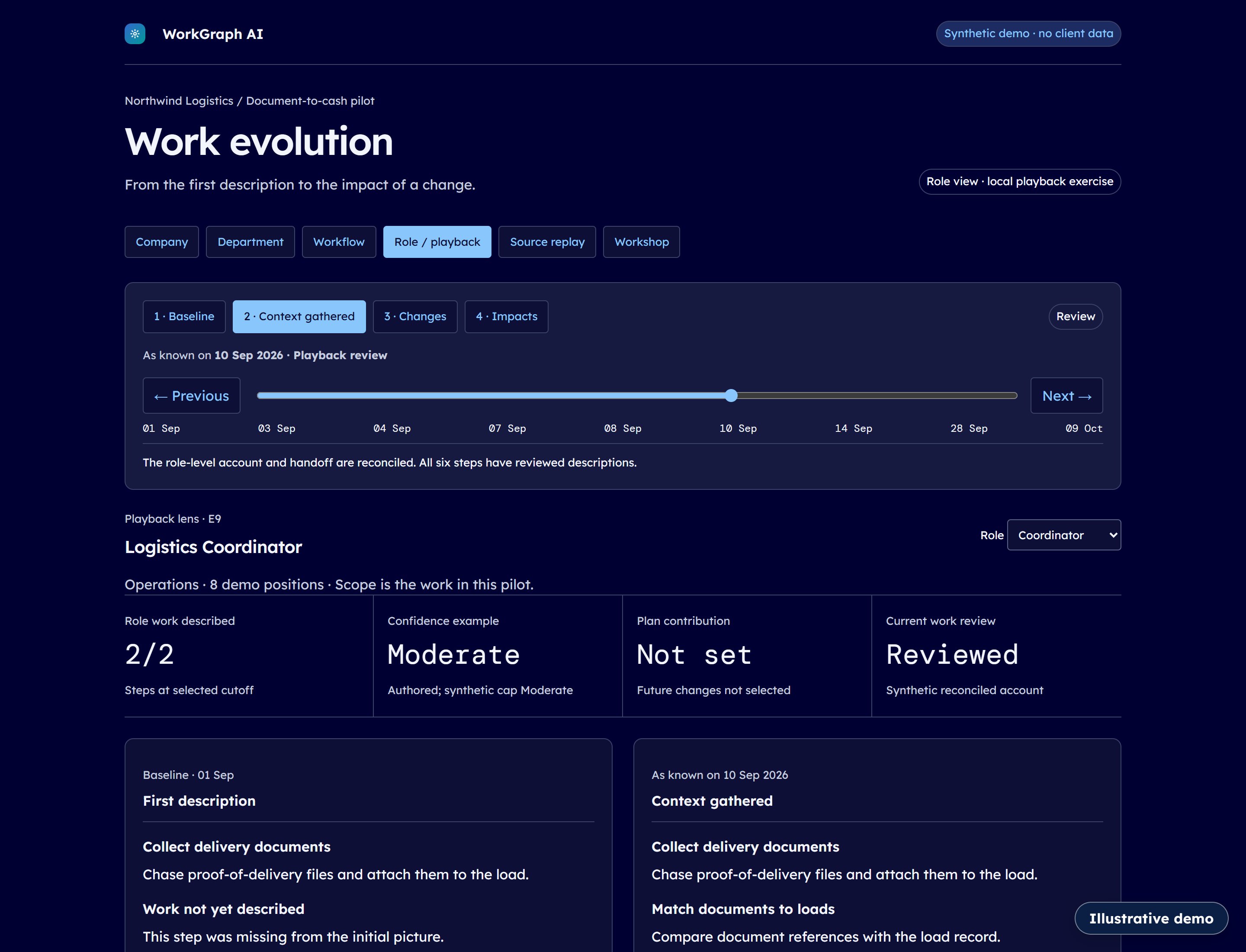
Map the work, make the call, then translate it to dollars.
Illustrative demo
Confidence improves with every layer of evidence.
People stay accountable for the interpretation and the decisions.
Job data
We start with a hypothesis from anonymized HR data and your job descriptions.
Short surveys
We refine it with short surveys that capture tasks, handoffs, and how long things really take.
Interviews
We finish by talking to the people doing the work and to leadership, and flag where their answers differ.
Your plan
A map of the work across roles, a decision on how each role changes, and the cost and evidence behind each one.
We tell you what to build and who should build it
You get a plan for your company, and we have no agents or tools to sell you afterward.
Not ready for a Blueprint? Take the free AI Readiness Snapshot.
By design, not by default.